
This article was authored by MMR Consulting, a Kneat Partner of the Year 2025. MMR specializes in digitally enabled capital project delivery for life sciences capital projects.
Turnover documentation has always been critical to successful Commissioning, Qualification, and Validation (CQV) execution. System Turnover Packages (TOPs) underpin installation verification, support qualification decisions, and serve as permanent records for audit and lifecycle management.
Yet despite their importance, TOPs are often handled in ways that create unnecessary rework — particularly at the interface between construction and CQV.
As digital construction and validation platforms mature, it’s worth asking: why are CQV teams still spending so much time reorganizing, reassembling, and re-reviewing information that already exists — and has already been reviewed — elsewhere? That question is central to an emerging API integration between Engineering Information and Document Automation (EIDA), a construction management platform, and Kneat’s digital validation solution, Kneat Gx. The integration was architected and implemented by MMR Consulting, combining deep construction execution knowledge with proven digital CQV delivery. While a full production case study is still in development, early small-scale implementations already demonstrate meaningful efficiency gains. When extrapolated to a large capital project, the value becomes compelling.
The hidden cost of turnover: re-organizing what already exists
In theory, construction delivers a TOP, CQV uses it, and the project moves forward.
In practice, the project TOP is often organized by trade, vendor, or discipline — delivered as a loosely structured document stack, with unclear system-level boundaries and inconsistency across packages.
CQV activities, and ultimately owner record retention, are system-centric, not trade-centric. That mismatch creates a significant downstream burden.
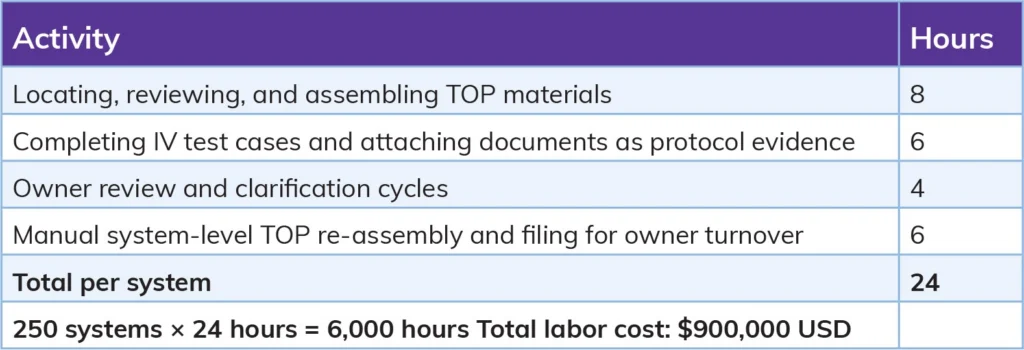
Before qualification can begin in earnest, teams routinely must pull documents from multiple trade packages, determine which system each document belongs to, and reassemble individual system-level TOPs. Those system TOPs then need to be refiled for CQV use, owner turnover, and long-term lifecycle management.
This work is rarely acknowledged in schedules or cost estimates — but it consumes substantial engineering and CQV labor.
One of the design goals of the EIDA–Kneat integration was to eliminate this unplanned rework entirely. The approach: establish system context once and carry it forward digitally.
What changes with EIDA–Kneat integration

EIDA fundamentally shifts how turnover data is managed. As construction documentation is processed, each artifact is tagged to its relevant system at the source. Instead of assembling TOPs at the end of a project, system-level TOPs are built continuously as work progresses.
Through the API integration delivered by MMR Consulting, this system-level structure is preserved as documentation transfers into Kneat:
- System TOPs are automatically compiled
- Documentation is pushed directly into Kneat, already structured by system and category
- Links back to the authoritative engineering source are preserved
- No manual document handling is required
The TOP becomes a living system record — not a static bundle reconstructed after the fact.
Rethinking qualification protocols
If automation ensures that the correct documents exist, are complete, reviewed and approved, and remain traceable to their engineering source, then many traditional CQV test steps can be simplified.
Instead of dozens of document-retrieval test cases, protocols can be structured as a checklist verifying TOP completeness, with acceptance criteria focused on engineering review outcomes and a direct link to the automated system TOP location.
This approach — enabled by tight integration design and CQV domain expertise from MMR — simplifies protocol authoring, speeds execution, reduces review cycles, improves audit clarity, and eliminates low-value administrative work.
A worked example: large-scale project ROI
The following applies realistic assumptions to a large life sciences capital project.
- 250 systems
- 40 TOP-dependent Installation Verification (IV) or CQV test cases per system
- Fully burdened engineering/CQV labor rate: $150 USD per hour
Baseline: manual TOP handling
Per system:
With EIDA–Kneat automated TOP transfer
Per system:
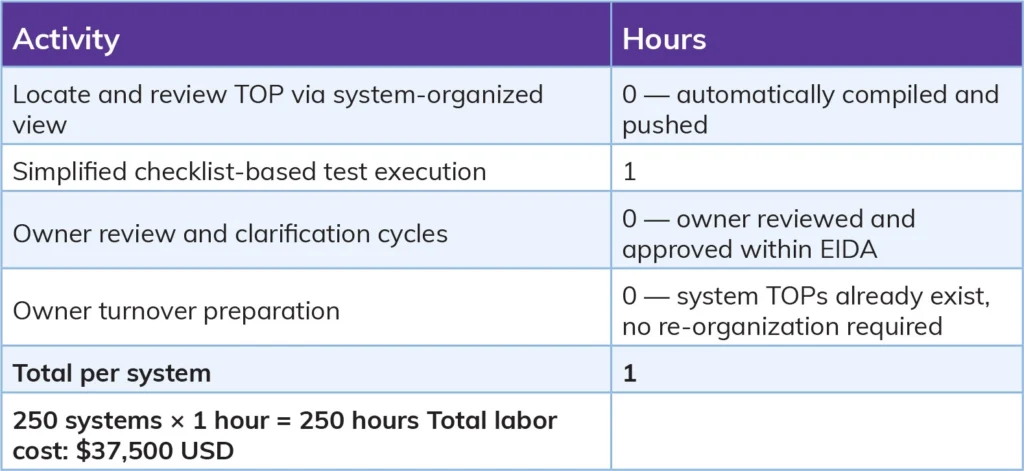
Estimated project savings
- 5,750 labor hours eliminated
- Approximately $860,000 USD in direct cost savings
- Improved schedule certainty and earlier system readiness
- Reduced audit and inspection risk
These results reflect not only the technology, but the importance of intentional integration design — something MMR brings through decades of experience bridging construction, CQV, and regulated quality systems.
Partnering to deliver integrated CQV
The EIDA–Kneat integration was implemented by MMR Consulting, recognized as Kneat’s Partner of the Year for 2025. That recognition reflects MMR’s continued leadership in deploying Kneat at scale. It also reflects MMR’s ability to align digital validation strategies with the realities of project delivery.
The bigger question
This isn’t just about automation. It’s about alignment.
If we trust engineering rigor during construction, CQV protocols should be written to leverage that rigor — not recreate it.
By integrating EIDA and Kneat, teams can eliminate document re-handling, remove artificial handoffs between engineering and quality, and focus validation resources on activities that actually reduce risk.
That’s not just a smarter CQV strategy. It’s a better way to deliver projects.
Learn more about MMR Consulting
To learn more about MMR Consulting’s approach to digital CQV delivery, or to explore how the EIDA–Kneat integration could benefit your next capital project, contact MMR Consulting.