
For five years, the State of Validation has tracked the industry’s long march away from paper. In 2026, something shifted — not incrementally, but sharply.
The 2026 State of Validation report, independently authored by a leading CQV expert and TU Dublin Lecturer Donncadh J. Nagle, surveyed 614 validation professionals across six continents. Section 3 of the report captures the clearest picture yet of where digital validation stands — and what it is delivering.
Where organizations stand: a new maturity benchmark
For the first time, the 2026 survey introduced a formal digital maturity scale aligned with the ISPE® Good Practice Guide: Digital Validation framework, giving the industry a structured way to benchmark progress.
The results reveal a profession spread across the full spectrum. The largest single cohort — 25% — sits at Level 3, a hybrid paper-digital model. A combined 35% describe themselves as predominantly digital or fully transformed (Levels 4 and 5). Meanwhile, 38% remain at Levels 1 or 2 — predominantly paper based.
No single level dominates. That distribution matters: it tells us the industry is not converging, it is stratifying — with early movers pulling ahead while a significant portion of the field is still navigating the starting line.
Adoption: the most significant single-year shift in five years
Since 2022, this study has tracked the proportion of organizations currently using or actively implementing a dedicated Digital Validation Tool (DVT). The trend has been upward throughout, but 2026 marks the steepest jump yet.
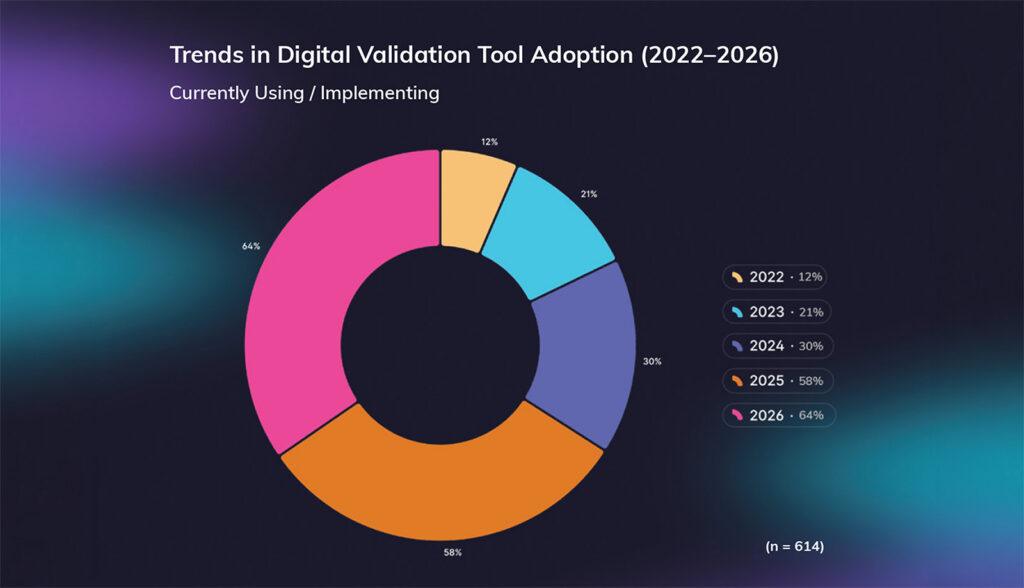
The headline number is 64%. But the more telling figure is this: full adoption has nearly doubled year-over-year, rising from 16% in 2025 to 30% in 2026. A large cohort of organizations that were “in progress” last year crossed the finish line. At the same time, the proportion planning to adopt in two or more years collapsed — from 16% to just 5%. Long-term deferral is no longer the default.
What is holding the rest back
For organizations that have not yet adopted a dedicated Digital Validation Tool, the 2026 data identifies the barriers clearly. Budget constraints remain the primary obstacle at 27%, consistent with prior years. Corporate approval processes and integration complexity each account for 15% — reflecting the organizational and technical friction that can stall progress even where intent exists.
Barriers to adoption
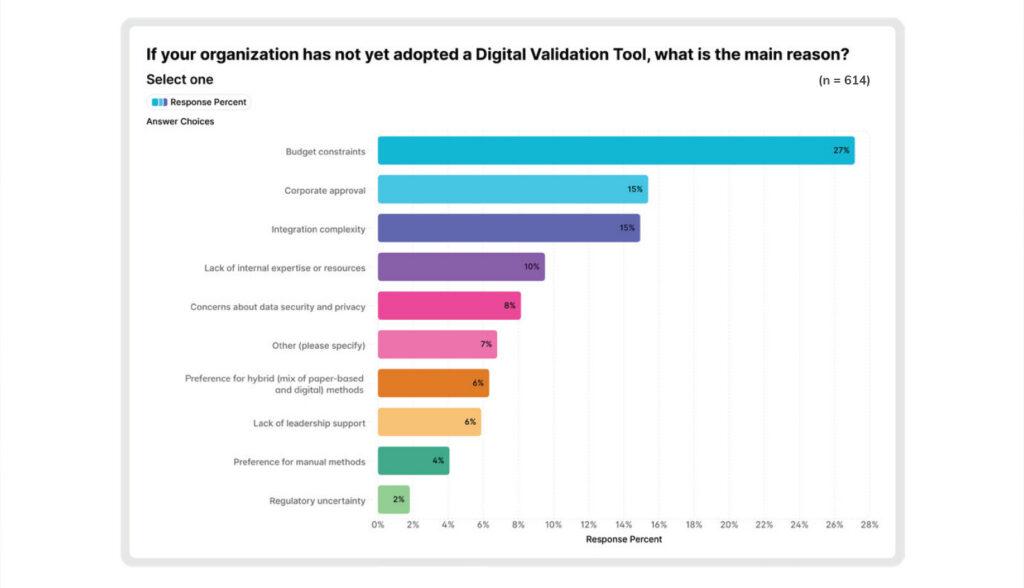
Notably, regulatory uncertainty (2%) and preference for manual methods (4%) are no longer meaningful factors. The question for most non-adopters is not whether to go digital — it is how to unlock the internal authorization and funding to get there.
What digital validation is actually delivering
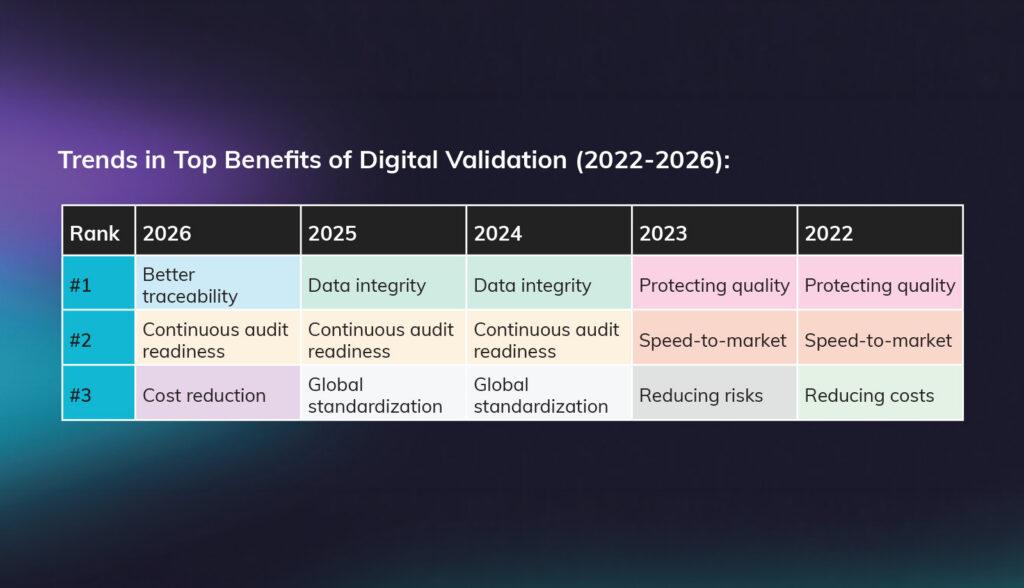
The benefits picture in 2026 reflects a maturing user base. Better traceability ranks as the top expected or realized benefit for the first time, displacing data integrity, which had led in both 2024 and 2025. Continuous audit readiness ranks second — a finding that connects directly to the broader pressures facing validation teams in GxP environments.
This shift signals something important: organizations are no longer asking whether digital validation tools improve compliance. They are reporting that the tools are delivering on that promise, and they are getting more specific about how.
The return on investment (ROI) data reinforces this. Among the 394 respondents with implemented or in-progress systems, 53% report that ROI has met or exceeded their initial predictions. Critically, 30% say it has significantly exceeded expectations — nearly double the 17% who said the same in 2025. The proportion reporting it is “too early to tell” has declined sharply, from 21% to 8%, as a greater share of implementations have now matured sufficiently to assess.
Want to hear the report author and validation experts discuss these findings? Watch the 2026 State of Validation webinar on demand.
What practitioners value most in a system
When asked to rank the functions most important to their daily validation activities, respondents returned a clear answer: an all-in-one validation suite, selected first by 39% of respondents. An auto-generated traceability matrix ranked second, at 29%.
The preference for consolidation over point solutions is consistent with the data across this section. Organizations are not looking for more tools — they are looking for fewer, more integrated ones.
What this means for your validation program
The 2026 data draws a clear line. Organizations that have adopted digital validation are reporting genuine efficiency gains, meeting or exceeding their ROI expectations, and naming better traceability and continuous audit readiness as the benefits they value most. The gap between them and organizations still operating primarily on paper is widening — not just in technology, but in operational capability.
For validation leaders evaluating or building the case for digital transformation, the 2026 State of Validation provides a direct benchmarking framework. The question is no longer whether the industry is moving — it is where your organization sits in that movement.
Digital validation is one part of a broader story. The full 2026 State of Validation report covers workforce trends, validation practices and priorities, digital adoption and ROI, AI in GxP environments, regulatory preparedness, and more.