
What the 2026 State of Validation reveals about today’s validation teams
The 2026 State of Validation report is here — and if you work in validation, the first two sections alone are worth reading closely. Drawn from 614 verified respondents across six continents and more than 30 industries, this year’s data paints a clear picture: validation teams are doing more, under more pressure, than at any point in the five-year history of this study.
Here’s what the data says about who validation professionals are, what they’re up against, and where they’re focusing their efforts in 2026.
A workforce in transition
The experience profile of the validation workforce has shifted meaningfully year over year. The 6–15 years cohort now represents 52% of all respondents — up from 42% in 2025 — making mid-career professionals the clear majority of the field.
Workforce experience distribution 2026 vs. 2025
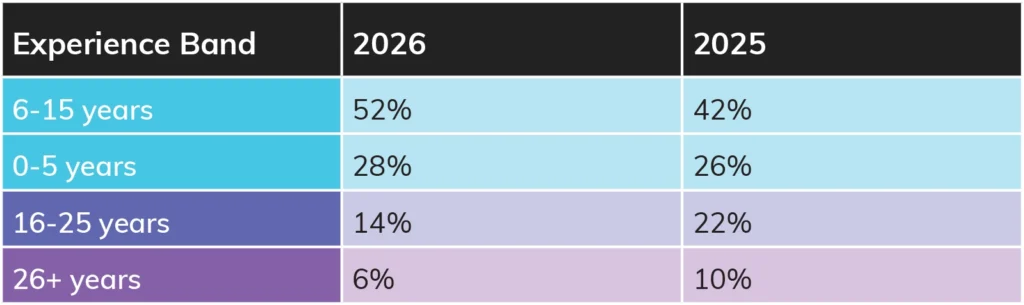
At the same time, the share of professionals with 16 or more years of experience has contracted, falling from 32% in 2025 to 20% in 2026. This is likely a reflection of the study’s expanded respondent base rather than an exodus of senior talent — but it’s a distribution worth tracking.
The pipeline of newer professionals remains healthy.
At 28%, the 0–5 years cohort is consistent with prior years, confirming continued entry into the profession.
Experience distribution matters for interpreting survey findings. Attitudes toward technology adoption, confidence in AI, and perceptions of regulatory risk are all shaped by how long someone has worked in validation. As the workforce profile shifts, so does the industry’s collective outlook.
Workload is back at its 2022 peak — and it’s not easing
The headline workload finding is stark. In 2026, 80% of respondents report that their validation workload has increased over the past year. That matches the peak recorded in 2022 — and reverses the modest easing seen in 2023, 2024, and 2025.
What makes 2026 different is the severity. Forty-five percent of respondents characterize the increase as significant — the highest proportion in the study’s history. Only 2% report a workload decrease, down from 9% in 2025.
Workload change, 2022-2026
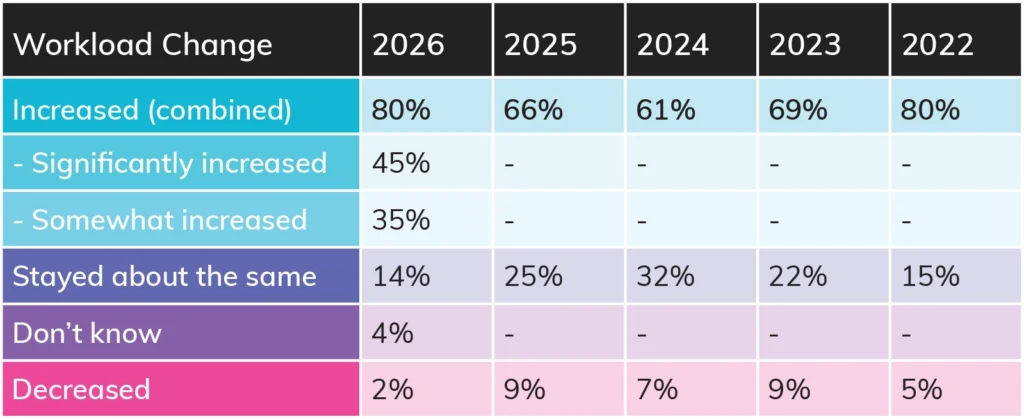
The brief period of stabilization between 2023 and 2025 has reversed. Demand is rising faster than resourcing — and the data makes clear that this is not a localized or sector-specific pattern. It is an industry-wide reality.
The top three challenges haven’t moved in two years
Audit readiness, compliance burden, and data integrity have held the top three positions in the team challenges ranking for the third consecutive year. That consistency is itself a signal: these are not episodic pressures. They are structural features of how validation teams operate today.
The five-year trend tells the full story. In 2022 and 2023, shortage of human resources and efficiency topped the list. By 2024, compliance-facing pressures had taken over — and they haven’t let go since.
Primary challenges facing validation teams, 2022-2026
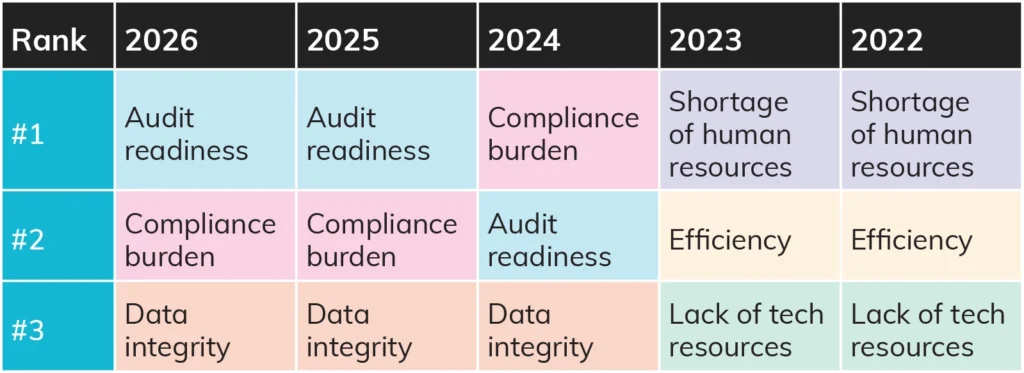
At the lower end of the ranking, speed-to-market and training and knowledge sharing continue to fall — not because they’re unimportant, but because regulatory pressures are crowding out longer-term priorities in day-to-day team focus.
Want to hear the report author and validation experts discuss these findings? Watch the 2026 State of Validation webinar on demand.
Priorities for 2026: compliance leads, cost reduction enters the top three
The priorities data mirrors the challenges data closely. Audit readiness takes the top priority position for the second consecutive year — with 29% of respondents ranking it first. Organizations are not just under pressure here; they’re actively investing to address it.
Trends in top validation priorities, 2022–2026
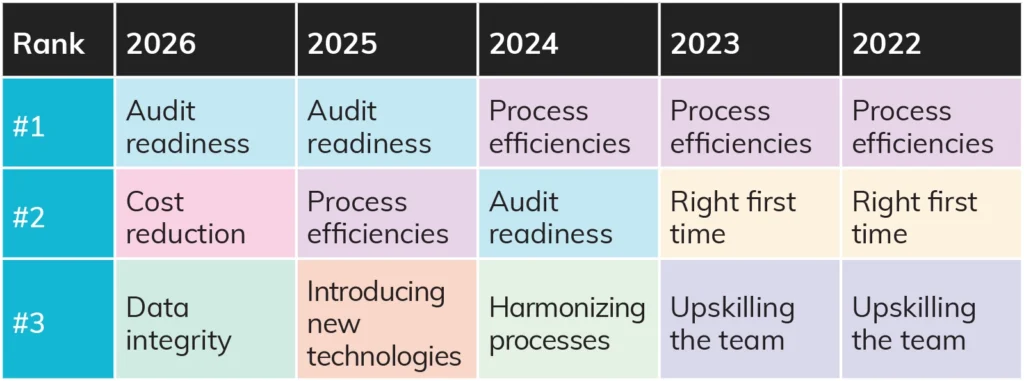
Cost reduction emerges as the second-ranked priority for the first time in the study’s history. That’s a notable development in a year of rising workloads and ongoing digital investment. Efficiency and value demonstration are now running alongside compliance improvement as strategic imperatives.
Data integrity holds third position, consistent with its long-standing presence across both challenges and priorities in prior years. Introducing new technologies sits fourth — its second consecutive year in the top four — confirming that technology modernization has moved from aspiration to strategic objective.
The multi-year trend in priorities is equally instructive. The shift from efficiency-led to compliance-led priorities is one of the most significant structural changes in the five-year dataset. Process efficiencies held the top spot for three consecutive years (2022–2024) before being displaced by audit readiness in 2025. Upskilling, which featured in the top three as recently as 2023, has now fallen to last place.
What this means for your validation team
The findings together point to a profession operating under compounding pressure. Workloads are at a five-year high. The challenges that dominate — audit readiness, compliance burden, data integrity — are the same ones that dominated last year, and the year before. And the priorities that have been crowded out — upskilling, workforce development, speed-to-market — are precisely the ones that would address long-term structural resilience.
The practical implication is clear: organizations that rely on manual processes and fragmented workflows are increasingly exposed. Those that have invested in structured, digital validation programs are better positioned to absorb the pressure — and the rest of the 2026 data bears that out.
The full report covers digital validation adoption, return on investment, AI in GxP validation, regulatory preparedness, and more.