
Validation professionals have a clear ask for the next four years: regulatory clarity. It’s the third-highest-ranked development respondents want to see improve validation outcomes, trailing only digital transformation and stronger data integrity controls.
Kneat’s AI in Validation whitepaper takes the AI-specific findings from the 2026 report data set, drawn from 614 validation professionals, and condenses them into a single, focused read. It’s built for anyone who wants the regulatory context and the governance takeaways without working through the full report.
A familiarity gap sits at the center of the industry
Asked how familiar they are with current and emerging AI regulations, 27% of respondents call themselves very familiar, actively tracking and interpreting developments. Another 34% say they’re somewhat familiar, aware of the key points without deep engagement. Combined, 61% describe at least some working familiarity.
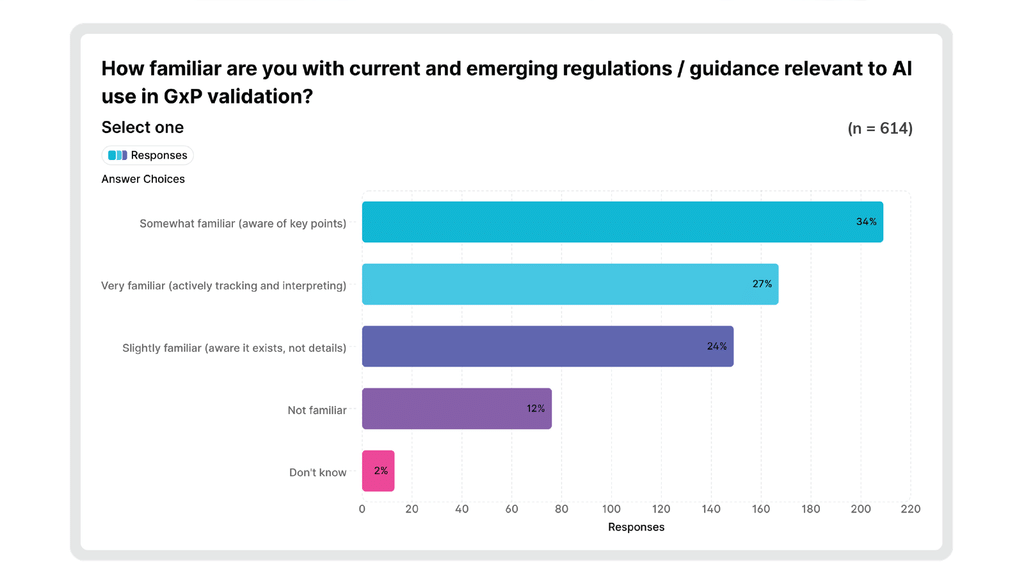
That leaves a meaningful gap on the other side. Twenty-four percent are only slightly familiar, aware that guidance exists without knowing the details, and 12% report no familiarity at all. In an industry where regulatory compliance is the core operating imperative, more than a third of professionals are navigating AI adoption without a firm grasp of the rules taking shape around it.
FDA and EU guidance lead, but nearly one in five have reviewed neither
When asked which regulatory guidance sources they’ve actually reviewed or used to inform their organization’s AI approach, respondents pointed most often to FDA discussion papers and whitepapers on AI and machine learning, cited by 35%. EU GMP and EudraLex guidance, including the proposed but still-pending, Annex 22, follows closely at 34%.
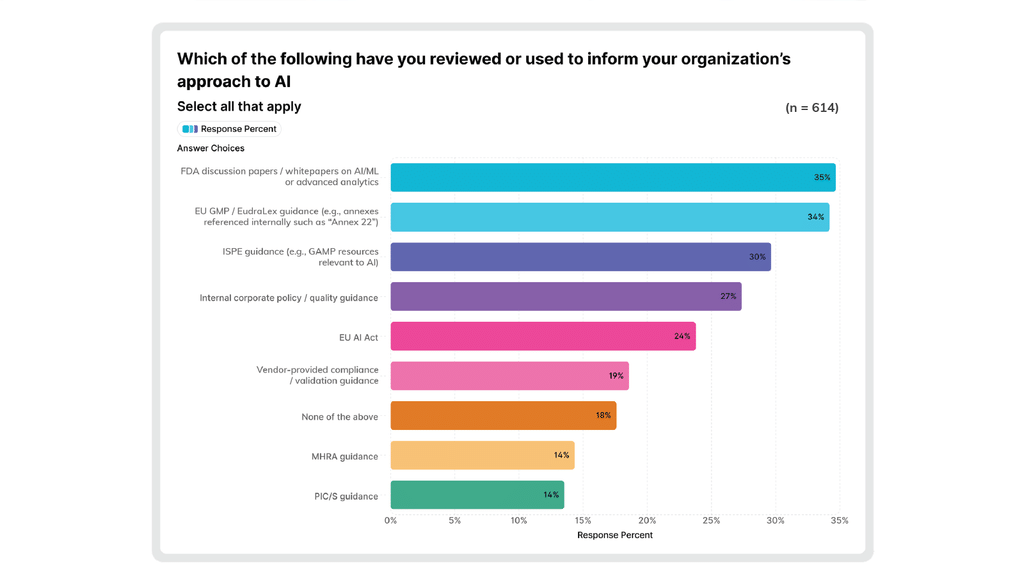
ISPE guidance, including GAMP resources relevant to AI, ranks third at 30%, ahead of internal corporate policy at 27% and the EU AI Act at 24%. Vendor-provided compliance guidance sits at 19%, with MHRA and PIC/S guidance each cited by 14%.
The geographic weighting of the sample, with North America and Europe representing 84% of respondents, helps explain why FDA and EU frameworks lead the list. What stands out more is the 18% who have reviewed none of these sources. Nearly one in five organizations shaping an AI approach in GxP validation are doing so without direct reference to any named regulatory guidance.
More than half are already preparing for AI-driven oversight
Despite the gaps in familiarity and guidance review, organizations aren’t waiting for finalized regulation to start preparing. Twenty-eight percent report an active preparation program already underway for increased AI-driven GMP oversight, and a further 27% are in early planning or gap-assessment stages. Combined, 55% of organizations have preparation work in motion today.
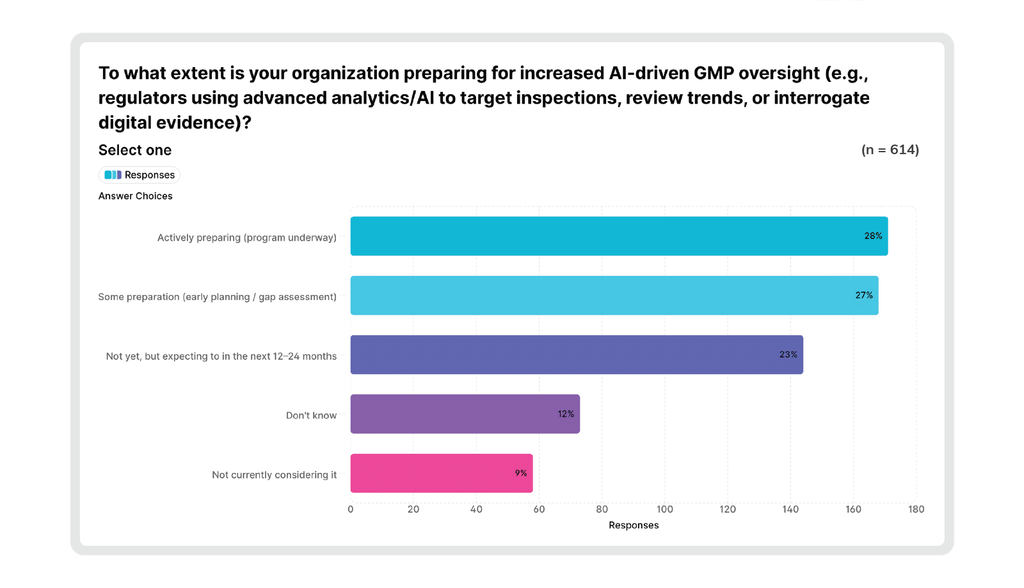
Another 23% expect to begin preparation within the next 12 to 24 months, leaving just 9% not currently considering it and 12% unsure. Preparation for AI-driven regulatory oversight is shifting from a future consideration to a present compliance reality, even as the underlying regulatory guidance itself is still developing.
The industry is defining its own boundaries for acceptable AI use
With formal regulation still catching up, validation professionals have a clear, self-defined view of where AI belongs in GxP work today. AI used for drafting or summarization, paired with mandatory human review, is the most widely accepted usage type by a clear margin at 53%.
Acceptance drops as autonomy increases. AI decision support that suggests risk ratings or actions, subject to human approval, is acceptable to 38% of respondents. Deterministic, rules-based automation with fully predictable outputs draws similar support at 37%. AI that executes workflow actions automatically, with an audit trail, is acceptable to 29%, while AI that makes or changes GxP decisions autonomously, without human approval, drops to 16%.
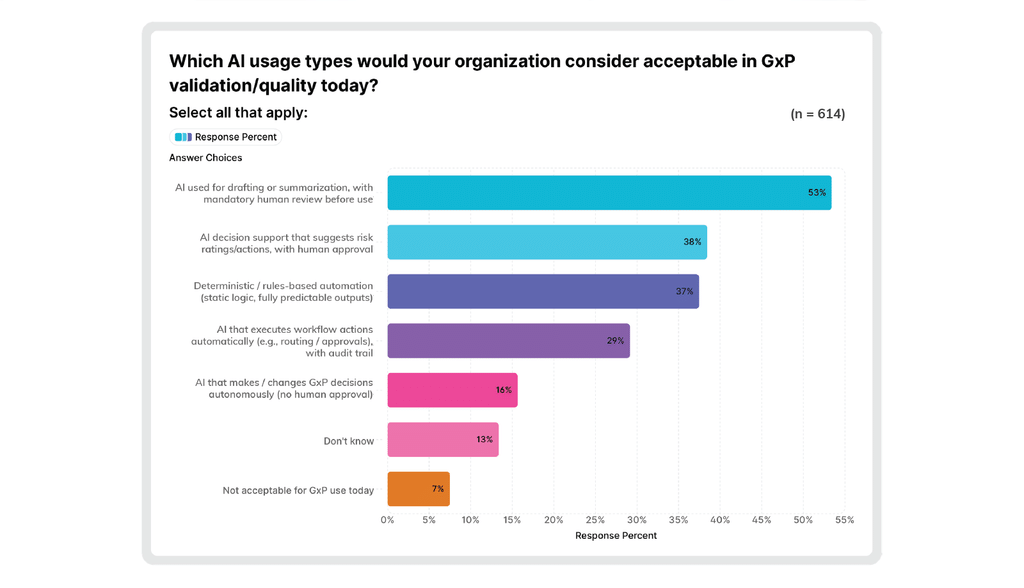
Only 7% say AI isn’t acceptable for GxP use today at all. Broad acceptance of AI in principle is established. What the industry is still working out, largely on its own and ahead of finalized guidance, is exactly where the boundaries of human oversight should sit.
Regulatory clarity, ranked against the rest
Asked which development would most improve validation outcomes going forward, 31% of respondents ranked digital transformation first and 35% ranked stronger data integrity controls first. Regulatory clarity came in third, with 12% ranking it as the single most impactful development, ahead of risk-based methods, workforce upskilling, and AI and automation itself.
Read alongside the familiarity and preparedness data, the message is consistent. Validation professionals aren’t waiting on regulators to define their AI approach for them. They’re building governance frameworks now, using the guidance sources available today, while asking regulators to close the remaining gaps.
The full report, along with the complete 2026 dataset across all four sections of the report, is available now.