
As validation teams look ahead to 2026, the message from the 2025 State of Validation report is clear: priorities are sharpening, expectations are rising, and “business as usual” is no longer enough. Audit pressure, growing workloads, and accelerating digital transformation are reshaping how organizations define success in validation.
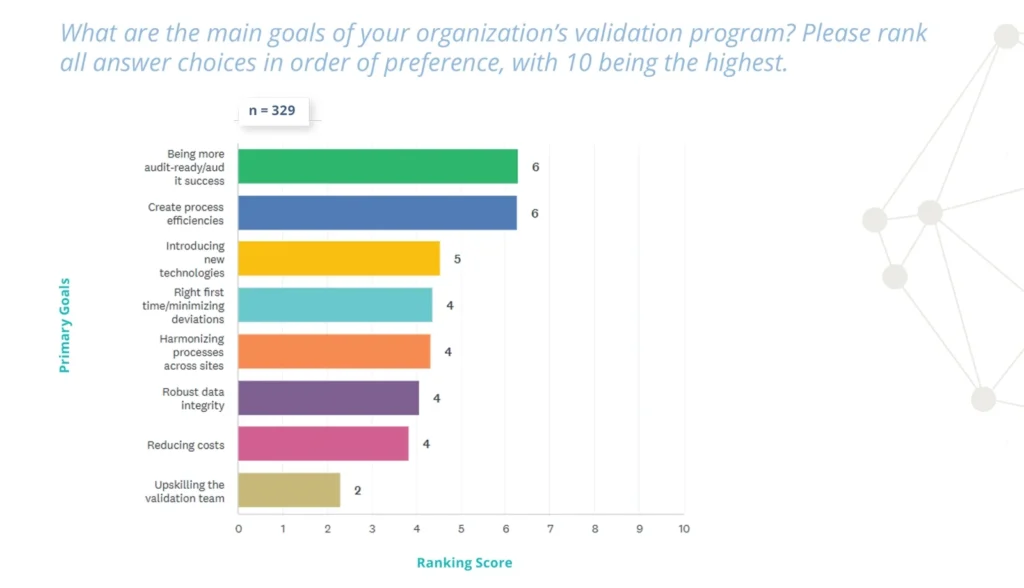
This article outlines the most critical validation goals for 2026 — as defined by 300+ global validation professionals — and what they mean in practice for regulated organizations.
Goal #1: Continuous audit readiness, not just audit survival
For the first time in the five-year history of the State of Validation report, being more audit-ready emerged as the top validation goal, overtaking efficiency and cost reduction.
This shift reflects a regulatory environment where:
- Audits are more frequent and less predictable
- Remote and hybrid inspections are now part of the norm
- Inspectors expect immediate access to complete, traceable records
2026 outlook
Organizations can no longer afford “audit prep mode.” The goal for 2026 is continuous audit readiness — where documentation, approvals, traceability, and data integrity are maintained in real time, not assembled under pressure.
Digital validation platforms play a central role here, providing a single system of record that supports inspection readiness every day, not just during audit season.
Goal #2: Process efficiency to offset rising workloads
Validation workloads continue to increase, while team sizes remain lean. Against this backdrop, creating process efficiencies remains a top-ranked goal — and a practical necessity.
But efficiency in 2026 is less about working faster, and more about:
- Eliminating redundant documentation
- Reducing rework and deviations
- Standardizing workflows across teams and sites
2026 outlook
Organizations will increasingly focus on efficiency as a capacity strategy — using structured workflows, reusable content, and automation to help small teams manage growing validation demands without compromising quality.
Goal #3: Introducing new technologies becomes a core priority
One of the most significant shifts in the 2025 data is the rise of introducing new technologies into the top three validation goals for the first time.
This reflects a broader industry realization: legacy, paper-based, or fragmented systems can no longer keep pace with regulatory complexity or business expectations.
2026 outlook
Digital validation is moving from “innovation initiative” to foundational infrastructure. Digital validation adoption is accelerating: 58% of organizations are now using a digital validation system, up from 30% in 2024. Many report meeting or exceeding ROI expectations, which likely includes cost savings.
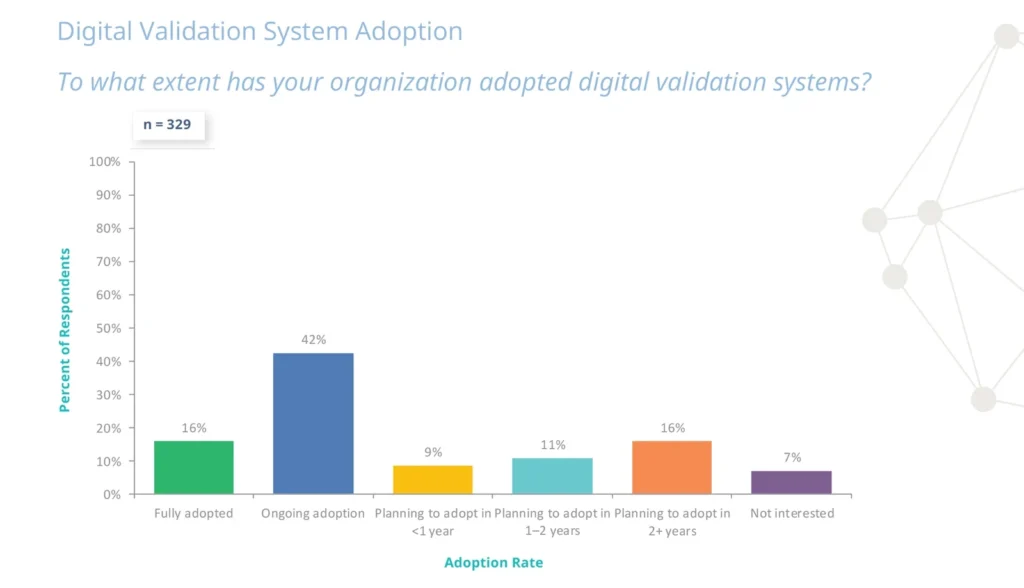
By 2026, organizations will be judged not on whether they plan to digitize — but on how effectively they’ve embedded digital systems into day-to-day validation operations.
Goal #4: Right first-time validation to reduce risk and rework
“Right first-time” validation continues to rank highly, underscoring a persistent challenge: deviations, documentation errors, and late-stage corrections remain costly and disruptive.
2026 outlook
The focus is shifting upstream. In 2026, validation teams will increasingly aim to:
- Embed risk-based thinking earlier in validation lifecycles
- Use guided workflows to reduce human error
- Strengthen traceability between requirements, testing, and evidence
This goal aligns closely with Computer Software Assurance (CSA) principles, even as CSA adoption continues to mature unevenly across the industry.
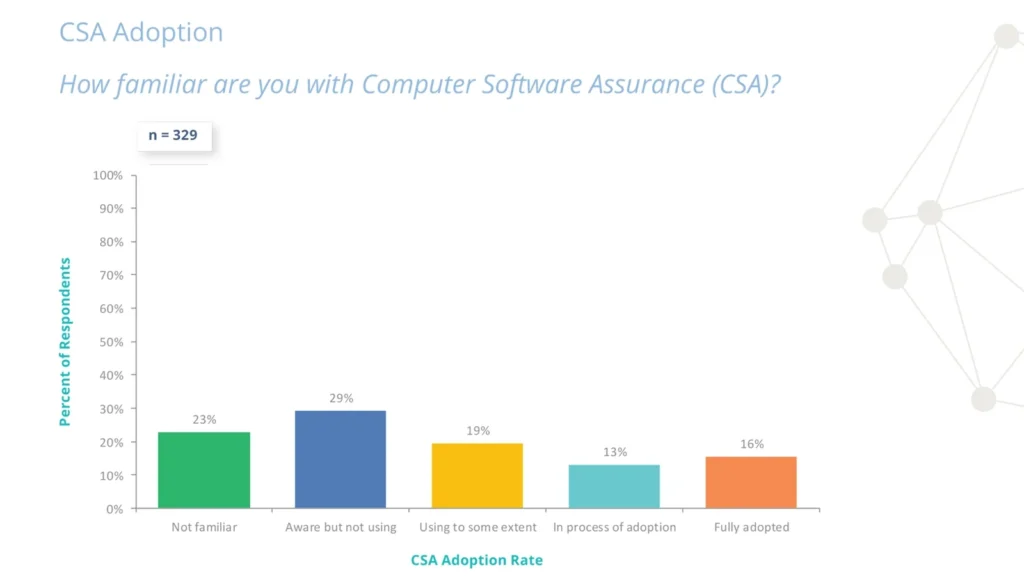
Roughly half of respondents are not using CSA, while the other half are somewhere along the adoption curve.
Goal #5: Harmonizing validation across sites and teams
As global organizations scale, harmonizing processes across sites remains a critical — and often elusive — goal.
The 2025 State of Validation data shows that many programs are still structured by site, leading to:
- Inconsistent documentation practices
- Varying interpretations of requirements
- Challenges during global audits
2026 outlook
Validation leaders will increasingly pursue harmonization through:
- Standardized templates and workflows
- Centralized governance models
- Digital platforms that enforce consistency while allowing controlled flexibility
Harmonization is no longer just an efficiency play. It’s a compliance and risk-reduction strategy.
Learn more about balancing harmonization with flexibility in this on-demand ISPE webinar featuring Kneat Digital Validation expert Amy Wilhite, “Standardize Globally, Adapt Locally – Best Practices in Digital Validation.” Watch now.
Goal #6: Data integrity as a non-negotiable foundation
While data integrity is no longer a “new” concern, it remains a top validation priority — and a driving force behind digital adoption.
2026 outlook
Expect data integrity to become even more tightly linked to:
- System access controls and audit trails
- End-to-end traceability
- Inspector confidence in digital records
In 2026, strong data integrity won’t just support compliance — it will underpin trust in increasingly digital and automated validation ecosystems.
What these goals mean for 2026 validation leaders
Taken together, the 2026 validation goals point to a clear direction of travel:
- From reactive to continuously audit-ready
- From manual effort to digital execution
- From siloed sites to harmonized systems
- From capacity strain to scalable processes
Organizations that align their validation strategies with these goals will be better positioned to manage regulatory pressure, adopt emerging technologies (including AI), and support faster, more confident decision-making.
At Kneat, we see these goals reflected every day in how validation teams are evolving — and in the growing role digital validation plays as the backbone of modern compliance.
Looking ahead
The 2026 State of Validation survey will continue to track how these goals translate into action — and where the industry still faces friction. Now is the time for validation leaders to assess their current state, benchmark against peers, and prepare for what’s next.
Want deeper insight? Take the 2026 State of Validation survey — now open — and help shape the next global benchmark for validation priorities.