
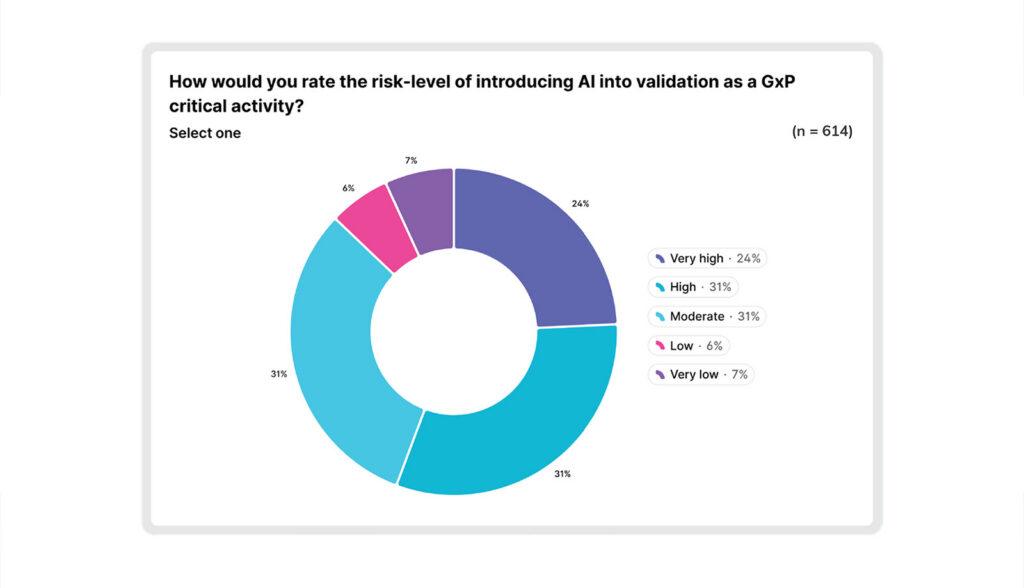
Validation professionals are not naive about the risks of artificial intelligence (AI). More than half rate the risk of introducing AI into GxP-critical validation work as high or very high. Yet 78% are confident AI will be a standard part of validation by 2030.
That tension sits at the heart of section four of the 2026 State of Validation report, independently authored by leading academic and validation practitioner Donncadh J. Nagle. The report draws on responses from 614 validation professionals across six continents and more than 30 industries. It shows how AI is being used today, what worries practitioners most, and how prepared organizations feel for what comes next.
In this ISPE webinar, Addressing the AI Governance Gap, Kneat’s experts Amy Wilhite and David Corley walk through a five-pillar framework for implementing AI in a way that satisfies regulatory expectations and delivers real operational value.
Adoption has reached a turning point
The clearest signal in this year’s data is how quickly “no AI consideration” has disappeared. In 2025, 46% of organizations reported no engagement with AI in any area. In 2026, that figure has fallen to 19%, the single largest year-over-year shift in the report.
AI adoption in validation
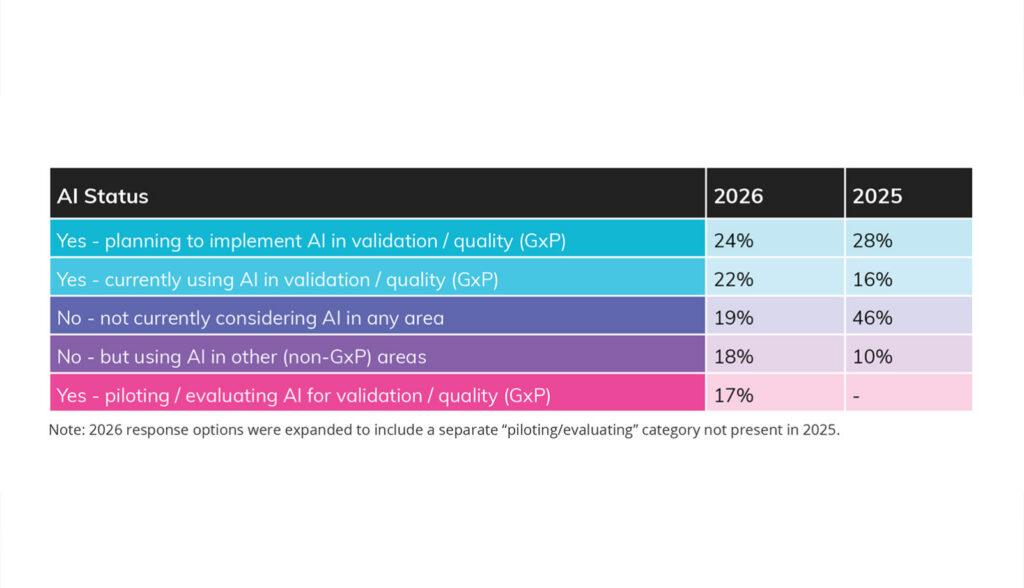
Organizations currently using AI in validation or quality (GxP) activities now stand at 22%, up from 16% in 2025. A further 17% are piloting or evaluating AI for GxP use, a category the survey did not track the previous year. Combined, 39% of organizations are now using or actively evaluating AI for GxP validation purposes. That is a more complete picture of engagement than the active-use figure alone.
Reported use cases center on protocol generation and drafting, data review and summarization, and requirements traceability. Change control review, deviation narrative support, risk assessment support, and test case generation round out the list.
Where practitioners expect AI to matter most
Asked where AI will have the greatest impact on validation, respondents ranked data review and summarization first. A total of 37% placed it at the top of the list, in line with the use cases organizations report today. Language translation and localization ranked second, a notable result for an industry that manages multi-language documentation across global operations.
We’re using AI to help with technical writing… do some level of research and pull references… even just flagging, that’s going to be significant.
– Validation Professional, Life Sciences Industry, United States
Protocol or test generation ranked third, up from its position in the prior year’s survey. This reflects growing comfort with AI-assisted document generation. Workflow automation and approvals ranked last, with 38% placing it at the bottom. Autonomous workflow management still sits at the far edge of what the industry is ready to trust to AI.
Accuracy remains the top concern
Asked about their primary concerns with AI in validation, respondents pointed overwhelmingly to accuracy, cited by 58%. Data security followed at 50%, with AI hallucinations and fabricated content close behind at 45% and regulatory compliance at 44%.
Concerns about AI in validation
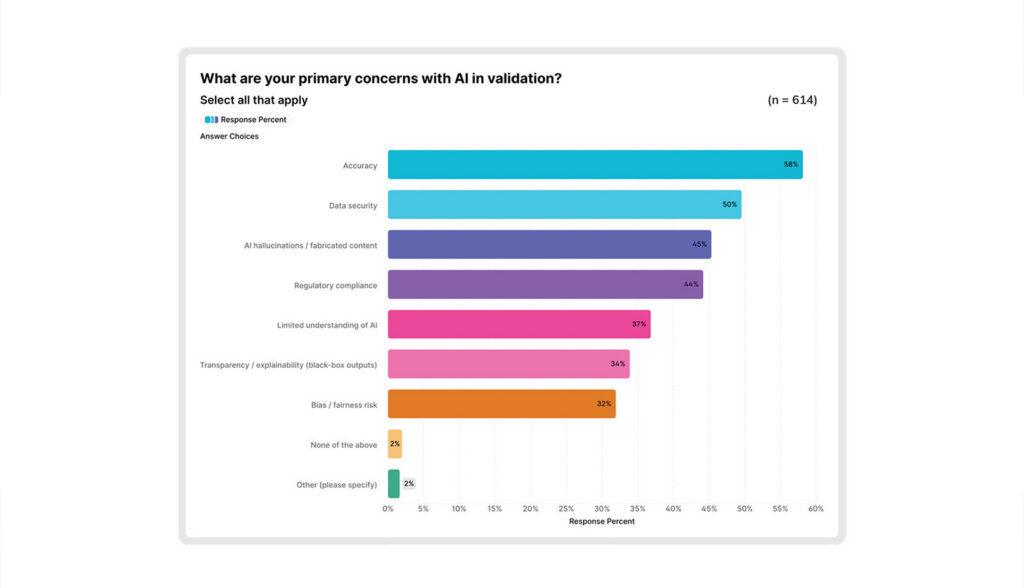
The appearance of AI hallucinations as a top-three concern is itself a notable shift. It reflects growing hands-on familiarity with generative AI tools and the specific failure modes they introduce. Only 2% of respondents selected “none of the above.” Concern about AI in validation is close to universal, even among organizations actively pursuing adoption.
More than half call GxP AI use high risk
Given those concerns, 55% of respondents rate the risk of introducing AI into GxP-critical validation as high or very high. A further 31% call it moderate, and only 13% rate it as low or very low.
AI risk assessment
Open-text responses point to consistent themes behind these ratings. Common threads include a lack of finalized regulatory guidance, including the still-pending Annex 22, and concerns about the explainability and auditability of AI-driven decisions. Respondents also cited the risk of over-reliance on AI output without adequate human review. Many also pointed to the broader challenge of validating AI systems within a GxP framework. Across nearly every response, one principle recurs: AI should augment human judgment in GxP validation, not replace it.
Confidence in AI’s future is high despite the caution
Despite rating GxP AI risk as high or very high, 78% of respondents remain confident AI will become standard in validation by 2030. Fewer than 4% consider this unlikely or very unlikely.
Confidence in AI as a standard by 2030
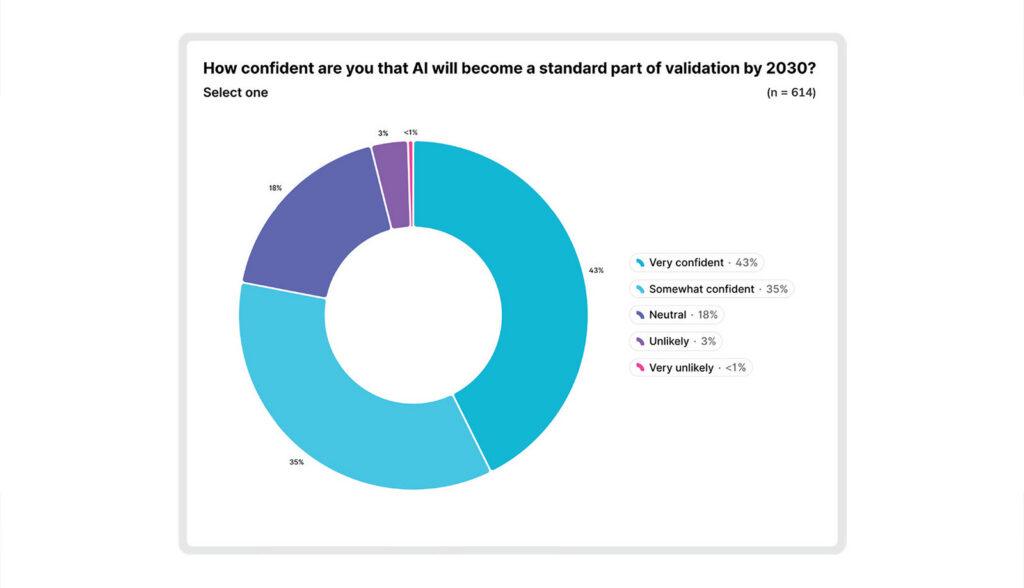
Read alongside the risk data, this is not a contradiction. It is a snapshot of an industry that expects AI integration to happen regardless of how it feels about the risk today. The next four years, in this view, are the window for building the frameworks and controls that make that integration safe.
The full picture
Section four of the 2026 State of Validation report shows an industry moving toward AI with open eyes. Adoption is climbing fast, and concerns are firmly in place. Practitioners still see digital transformation and data integrity as the priority, ahead of AI itself. The full report, along with the complete 2026 dataset across all four sections, is available now.